
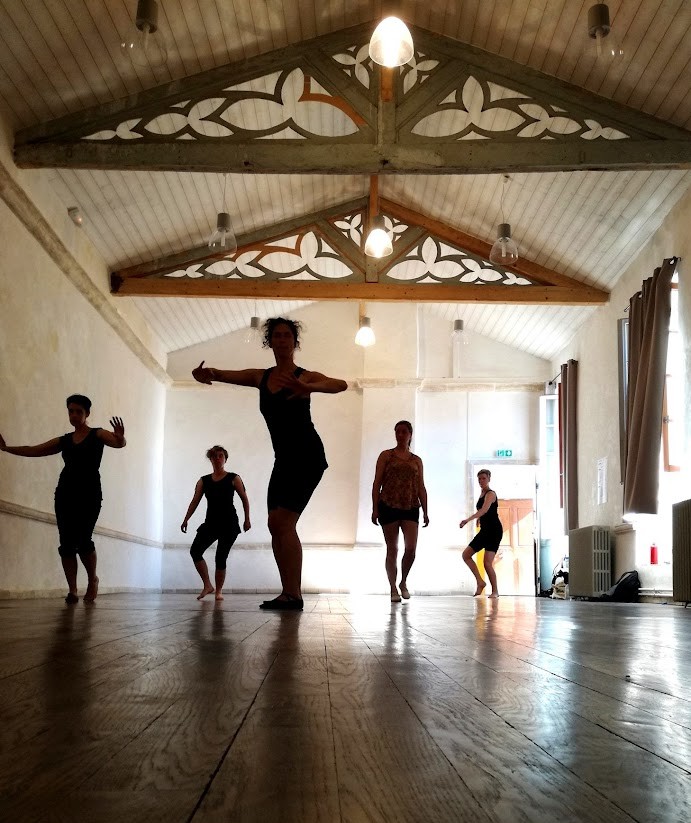
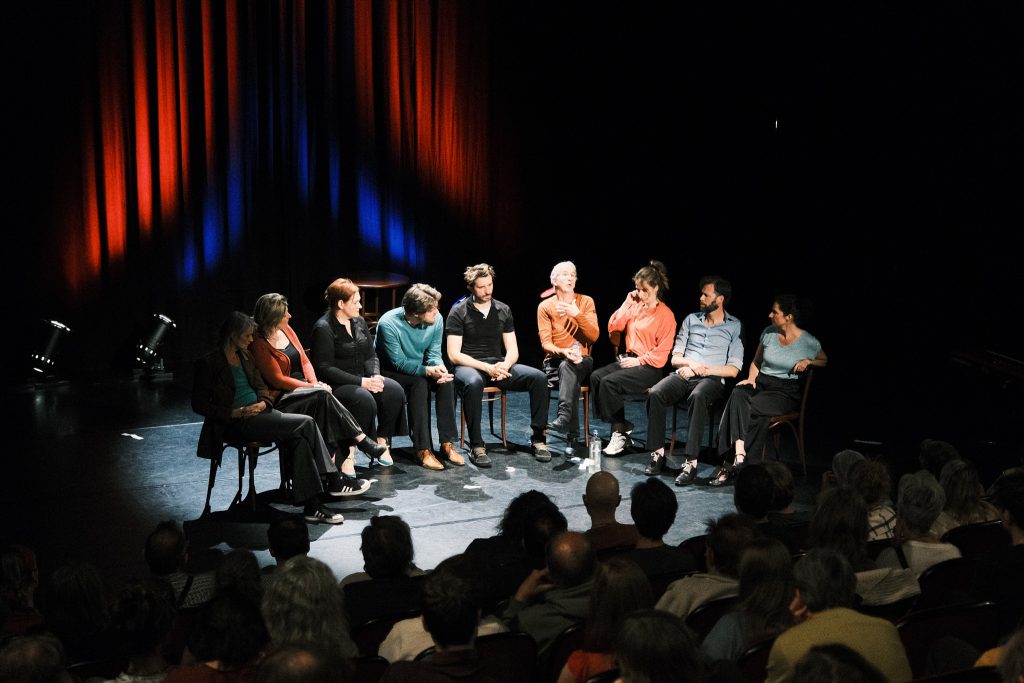
Put twelve people in a circle, and something magical happens that you simply can’t achieve in any individual conversation. Yet the world of organizations still revolves around the individual: the single leader, the one-on-one conversation, the speaker alone on a 100-square-meter stage. It’s time to put the group on stage—literally and figuratively.
Learning Together, Celebrating Our Differences, Playing Together
I love groups. As a teacher at a Freinet school, as a team facilitator, and as an improviser: time and again, I’m fascinated by what happens when people come together. Co-creation and synergy emerge, differences become visible—and therefore valuable—the social fabric grows, and we can draw on the strength of the collective. Learning together, embracing differences together, playing together. Humans are social beings by nature, so it makes sense that we thrive and grow in groups.
A position from the Kama Sutra
Despite the word’s etymology, organizations are controlled by the individual. The taken-for-granted nature of ’ones.‘ Why not have a two- or three-person leadership team instead of an individual leader? And why is there such an emphasis on ’one-on-one” conversations? First, it sounds like a position from the Kama Sutra; second, it’s extremely time-consuming. Why not, for example, conduct performance reviews in groups of three or four employees? Personal feedback happens within the group anyway. But then it’s fragmented and hidden—at the coffee bar and in the stairwell. Many conversations can be held openly and transparently in a group setting. If necessary, with thoughtful external facilitation if it’s not yet a part of the culture. Exciting, but highly effective. Transformative, too.
The Performing Arts as a Source of Inspiration
Almost all of us want less rigid hierarchies, but in practice we see that the role of king or empress is still very much present in the workplace. Or that conversations take place only along vertical lines, rather than in circles. And yet, things can be different. In addition to individual employees and their leaders, ‘the group’ deserves more attention and authority than it currently receives. The performing arts are a powerful source of inspiration in this regard. Improvisational theater places a strong emphasis on storytelling and collaboration. Think of practicing engaging conversations through group role-playing. In this way, we’re not only engaging in experiential learning but also in collaborative learning. How behavior comes across is situational, dynamic, and subjective. The more voices that participate and reflect on this, the richer the insights, and the greater the reward.
The universal is personal, and the personal is universal
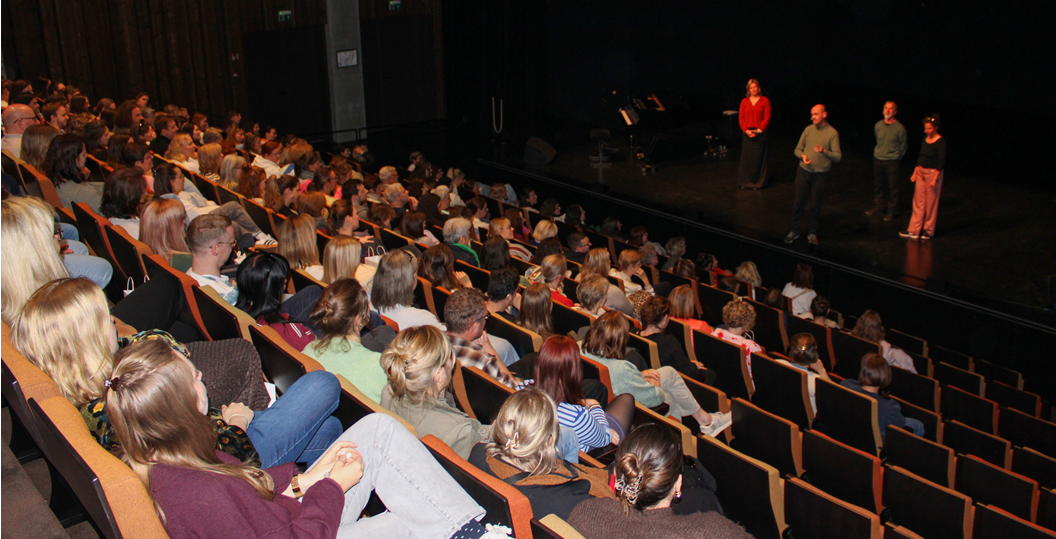
Improv theater featuring anecdotes from the entire audience is also a great example of working with the group. When we take an exploratory approach to a theme, we draw a great deal of inspiration from listening to many stories. A few well-crafted questions keep the microphone circulating smoothly among the audience for half an hour, after which we weave the anecdotes together and amplify them into a grand theatrical patchwork. Co-creation between improvisers and audience members at its best. During these performances, people realize how universal the personal is—and how personal the universal is. Someone put it this way after a performance for social workers: “It’s a relief. Being able to tell our stories, hear them from one another, and see them played out so creatively. It lightens the burden without denying the seriousness.”
When Lines Shatter the Circle
Often, the magic begins even before the performance. When preparing a customized thematic performance, we interview several people in advance. And we do that as a group, not individually. Part of the work—understanding each other better and writing new chapters of our collective stories—already takes place during that briefing, even before the performance. Sometimes this leads to unexpectedly transformative work. We once heard from a working group that, in their view, more had happened during that one-hour briefing than during the weeks when a consultant had interviewed people one-on-one, followed by an uncomfortable group session within the working group. At the time, people were suspicious of everything that had already crept beneath the surface during those individual conversations and the coffee-break chats that had arisen as a result.
Coming Together
To understand each other’s perspectives, we need imagination. To get everyone on board, it helps when the body can participate—when things can be expressed through theater. Theater can depict possible and better futures. When the actors can bring these to life not only through the content but also through their ensemble work, it generates tremendous power. Time and again, participants—whether in workshops or performances—, samener become when they go outside I experience so much job satisfaction. Especially when something has not only been experienced together, but also created together. Something that everyone takes with them to other places. Each in their own way. Same-same, but different. And that is almost the title of our performance on diversity and inclusion, About differences together.
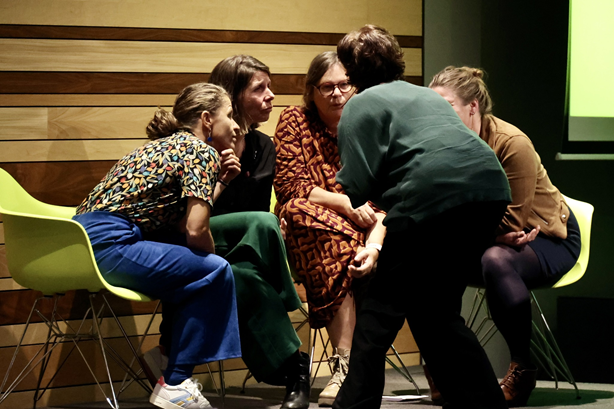
Interactive theater at UPC Duffel, photo by Goedele Miseur