
In anticipation of the expected increase in VAT for artistic services, I decided to do another VAT check-up of our various activities with the accountant and the social secretariat. In itself, it has always been clear to us what constitutes an artistic performance for VAT purposes and what does not. Thematic performances and the work of an actor in a role play in a training course are: actors acting, 6%. Trainings and workshops, including theater work forms, are not: trainers training, 21%. When 1 person gives training and occasionally acts in it, the performance as a whole is training. All clear.
But the foolishness we were told about the new VAT laws made me want to check it out. If a rock concert was going to get a higher VAT than an opera, I felt the pinch. Both role-playing acting and improvisational theater are sometimes under art fire. After all, we've heard the comments below in many variations.
- Improvisational theater is entertainment, not art.
People are having too much fun? There is too much no-nonsense interaction? They never get naked? (just kidding) - Corporate theater is not pure enough to be art.
They sell their souls to the devil? They allow themselves to be used to roll out someone else's agenda? Surely those of Inspinazie are too commercial for our cultural center? - Role-playing is just instrumentalization of theater.
That's not free enough to be art, is it?
The anxious guarding of purity and progressiveness does put art in a sterile space. It makes it apolitical and elitist. Fortunately, in recent years social-artistic work (in the very broad sense of the word) also seems to be much more widely embraced from within the arts again. And fortunately, the Council of State whistled back the puzzlers of the VAT legislation. There is no question of a few ministers deciding what is real art and what is not.
Whether it is a challenge to be in thematic improvisational theater for organizations and businesses put art first? Definitely! We've been taking that on for a quarter of a century. In fact, at one of the annual world conferences of the Applied Improvisation Network, we brought a workshop with this apt title: Keep the Art in it. This is necessary, because in that network there are two streams running. On the one hand, there are improvisers who take the mountain to Moses, and on the other, consultants who pick the low-hanging fruit of improv training. Clean, well within comfort zones, not antagonizing anyone, minimal effort with maximum payoff. Jazzy annual meeting with the management team? Check!
So in itself, I understand very well the reflex to protect a domain. The difference is in what you do with it. Do you retreat into an ivory tower, or do you open the doors of your world? We choose the latter. We do withdraw from time to time to work on themes and formulas that no client asked about, but we feel the need to work out. That keeps us sharp and grounded in all our work. We are not circus monkeys.
Thanks to the VAT question, at least for the past few weeks I've been looking at our work with art glasses on keenly. There are visible and invisible codes that make theater theater, or art art. We take great care with those codes. Below I discuss some examples.
Theater setup
We played the first of a series of “Just Say It” performances, for 40 employees of a production company. When we arrived, we saw that the auditorium was in classroom seating. We asked that the tables still be removed. A discussion ensued briefly because the owner of the seminar center understood this arrangement to mean theater seating. The principal had a hard time hiding the fact that we seemed like a case of stagingitis. She was also a bit worried when we had the projection screen rolled up, because she needed it afterwards. Ingrid, when we had already started, still ran to a window at the back of the room to draw a curtain. Eye roll.
But afterwards, the client understood why all this was so important. Theater is a dialogue between audience and players, between one's own world and another. The secluded coziness and closeness underscored: we're going to dive into this together!
A play is a piece. A piece defined time and space for imagination.
From simulation to experience
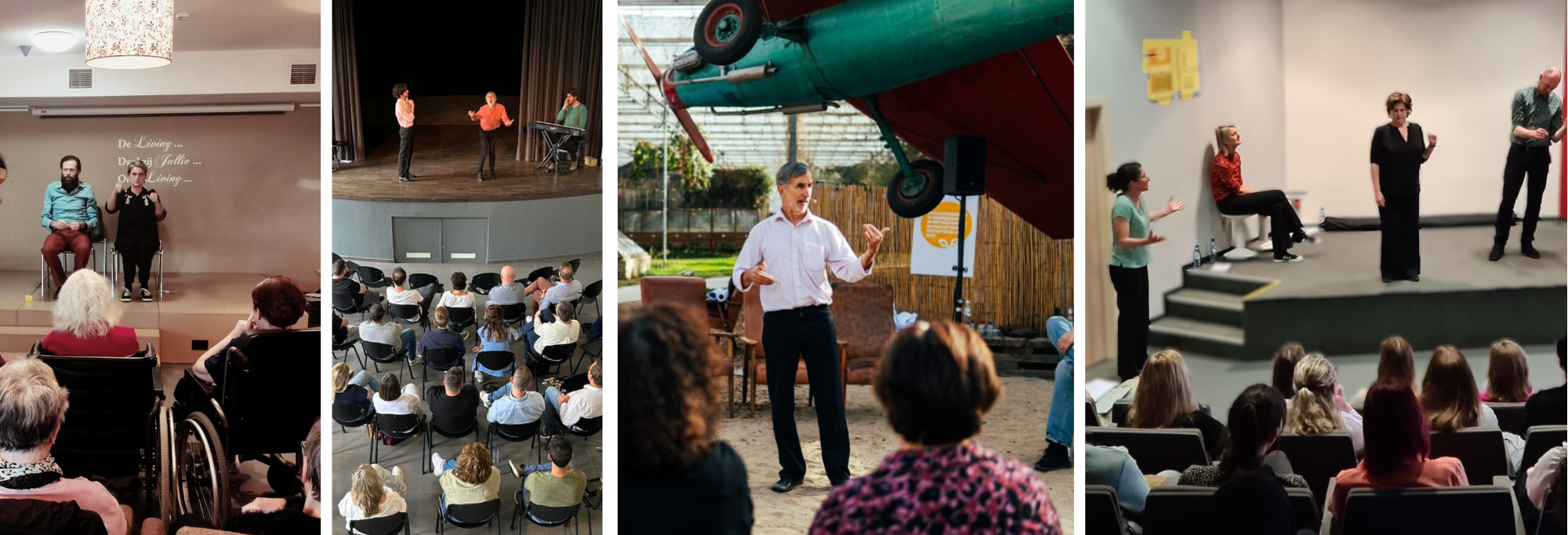
In a brand-new collaboration for role-play training within a safety project in a company, there was an instant click with the trainers. It was immediately clear that during the role-play sessions scripts were allowed into the background, even if the context was full of protocols in a high-risk environment. Scripts are extremely important, but paradoxically, you often haven't really learned them until you can let them go. You can't invent that, you have to do that. In real life. A manager talked a four-person team into not closing the gate behind them. As an actress, Leen poked the other participants with whom she made up the team a bit to play the jolly minimizing pleasantries. The executive took a step closer to his team, looked at them and slowly put his hands on the shoulders of two of them. Automatically they became silent and moved closer together like slow magnets, in a small circle. The executive repeated the gate rule, and nodded kindly and decidedly around. Everyone knew, that gate would no longer stay open.
The participant had technically skipped some steps of the addressing protocol. If someone had described this scenario, it probably would have been said that this was kindergarten. If it had been in an overly managed form of training acting, the moment might have been interrupted and disappeared.
The free role-playing worked. Because in that moment the participant embodied the intent of the script, and was able to express it in a completely unique and authentic way.
Role-playing is a golden gateway from empowered concepts to unique realities.
Theater, by the way, makes you forget what is “real” and what is not, it just doesn't matter in that moment either. The experience feels life-like. Strong role-playing is a magical way to engage in experiential learning. Herein lies the difference between a simulation game (mimicking a desired and known reality) and a theatrical role-play (experimenting with possibilities in the unprecedented). During a simulation game a lot of attention is paid to technical aspects and content of conversations, this is also the focus (and sometimes this is the best working form for your purpose!) In a role-playing game we investigate people's issues in the undercurrent. In doing so, you have to be able to let go of content and bring behavior and relationship explicitly into awareness and conversation.
From protocol reenact to true interaction between autonomous individuals.
From simulation to experience.
From experiential learning to experiential learning.
Making that possible is literally and figuratively an art. It also requires that trainers and actors be able to dance a kind of tango with each other, where each can bring their own role fully to the fore.
Sitting in the fire
Art chafes. Stretches boundaries. So does a good role-playing game. Leen and I are currently working with Joep and Peter of Kessels & Smit in what they are Studios mention. These are the role-play-based practice moments in their training programs, among others.
In such a Studio, there is plenty of time and therefore space to systematically increase participants' stretch zone in a role-play as an actor. I regularly read and hear how carefully role-plays are set up. Of course it is not the intention to frame and block someone. But I think it is often too cautious, too close to the comfort zone of most of the group. Opportunities are missed.
After a Studio role-play, I said something about an exceptional possible version of the situation played, but also that it was irrelevant to play that. “YOW,” one participant exclaimed. “That's much more relevant to us than you think and it if we don't address it here it's not going to happen.” What unfolded next was particularly exciting, and serious boundaries were pushed. In moments like that, in an intimate role-play, you get the feeling that a forum theater with 100 people (Theatre of the Oppressed, Augusto Boal) can generate. Magical power.
When participants throw oil on the fire themselves, not for the thrill, but out of their own desire to learn, and then so bravely stay in it: bow!
Fiction & metaphors
“Yeah but, that's not how it goes in real life,” is a common excuse from role-play participants when they are still in the resistance to fly into it.
“Yes AND, that works béter,” we say. We just raise the fiction. We take inspiration from real-life situations, and then distance ourselves from them. We will never use the name of the real person any case is about. We don't even necessarily use the exact context of the participants. This distance just creates space to look at one's own behavior with different eyes. This distance creates not only a safe space where so much attention is focused, but also the brave space to test other behavior. People do have enough imagination to put themselves (they are not playing a character) in the situation being played. Although sometimes they need a push. That too is art: letting people push the limits of their perceived ability. Art is sport for the soul.
In recent years, Professor Griet Peeraer and I developed a real world in which a whole set of role-playing games take place. De Beer is a bistro and residential seminar center. On this fictional professional shop floor, many people, from managers, civil servants, caregivers to investment fund managers, have already gone through all kinds of situations with regular characters from The Bear. They remain themselves, still not having to play a different person, just temporarily exercising a different profession. Time after time, it shows how recognizable the shizzle is, and how well they can translate the experience to their own context.
By the way, Griet once made a very interesting post about the effectiveness of role-playing, which you can find here.
Imagining possibilities
We got to wrap up a study day for education professionals. It was about the large number of young family caregivers (1 in 5 young people!) Bill played Jorik's French teacher, who initially focused on the time after time late work was turned in, and didn't read it either. After all, you can't just keep allowing exceptions for everyone, can you? When you give a hand they take an arm. The known. Until it turned out that the young student had put his experiences as a caregiver into his writing, and there lay a gem that later won a writing contest. Clean how the teacher had still allowed his curiosity. Melancholy and cliché. But also a story about how something that just seems like a burden from outside the school that needs to be managed can also have a place IN schoolwork.
From Yes But to Yes And. You can't imagine that enough.
Sometimes clients try to manipulate in advance - sometimes unconsciously - which outcome should be shown, or just barely. Then we tell them we are not going to follow that. We play from conversation with the audience, in complete freedom and transparency. If patrons want to contribute their reflections during the performance, gladly. We encourage that too. Then the aforementioned field of tension becomes part of what we play. We never let ourselves be taken for a ride, and will not package a message that a management does not dare to express directly themselves. As a result, a very exciting piece of the transformation work already happens during concept development. Sometimes it leads to assignments that push far more boundaries than a client had in mind. Sometimes it leads to jumping off a deal. Then we don't get paid for the sanding work. But voilà, all for the art!
Drama
There is no workplace without drama. Emotions and conflicts are abundant there, even if that is usually suppressed or controlled in all sorts of ways. (Enter burnouts.) Coming to play theater in the middle of that blind spot is often a catharsis already for the sake of (h)acknowledgment.
After we played in a company that was organizing an alternative activity on communication for the very first time, a woman came up behind us when we were already on our way out: “You guys really, really need to know that what you played there in that last scene, that that was almost word for word as it went on in real life. It's almost creepy!”
Beyond recognition, theater opens new worlds. It is Year of the Peasant Woman. During a performance for agricultural and horticultural women, we played a clash between a livestock farmer and a hiker who hurled a comment at her head about the calves being separated from their mother. Afterwards, someone joined Marc at the reception and she spoke emotionally and openly about the ambiguity in her calf love. He told us afterwards that he felt how she was still speaking to the character. And he was still humming along.
Was it an exercise for connecting with the next hiker? The seed for a longer bond between cow and calf on that farm? Who knows.
Participatory theater is practicing in the here & now for situations in the there & then.
Boal aptly calls it “Rehearsal for Reality.”.
The universal in the personal
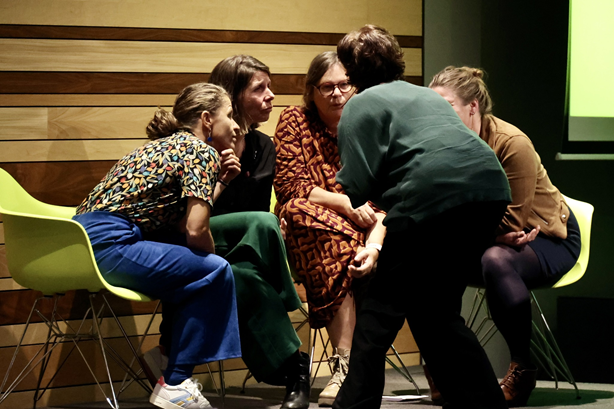
Art touches and connects.
We hear this a lot: “Are you guys working here? Have you been spying on us? You guys know exàctly what it's like here!” People often seem to think that the specific nature of their job or their position determines workplace behavior. They think that organizational culture is a figment of HR's imagination. They don't realize that at the root of that culture are human relationships and the behaviors by which those relationships are identified. Interactions take place on two axes: that of status (top-bottom) and that of closeness (repulsion-attraction). Boss, slave, friend, foe. Every toddler knows this. And essentially every play is about those two axes, and how we can move and change within them.
It doesn't get more complex, to the regret of those who want to put all this into complicated theories.
The trick is daring to recognize how simple it is in theory and how exciting in practice. Therefore, there is only 1 way: do. To relate is a verb. Hereby a deep bow to the late Professor Emeritus René Bouwen. He is a great inspiration in this, and we are happy to work with many of his disciples.
Back to the VAT issue
We now know from the VAT expert at our accounting firm that our way of applying VAT rates is still the right way. For now, art seems simpler than takeout.
In addition to the additional focus on our own work, February brought inspiration for the great philosophical What is Art? - question:
- the abrasive (and therefore engaging) nature of the Culture & Care conference in Leuven (more on this later, the theme for March will be Care)
- joining the Arts on Referral network
- The train-the-trainer courses Living Impro and Using Role Play
The month of February brought an advice I would like to give to ministers returning to the VAT drawing board.
Art should not go from 6% to 9%.
Art deserves a VAT exemption.
Want to learn how to better use role-play as a trainer or facilitator? The subsequent training will take place on Aug. 26.
Want to come and practice exciting conversations yourself? Starting in May, we are again providing sessions in open offerings.
During role-plays with actor we will work on your learning question. Small groups, unforgettable experiences, strong learning transfer! More info and dates coming soon.
Subscribe to our newsletter To stay informed of our offerings through your mailbox.